2027
Blauwe Long (Blue Lung)
About 50 boats of sailors who are out a lot, one full season on the North Sea coast, Wadden Sea, IJsselmeer, Markermeer and Zeeland. The first real fleet. We're looking for funding.
It started with a practical question: when is Amsterdam canal water fit for the garden? Measuring it showed how far salt from the North Sea reaches inland, and raised a bigger one: what if the boats already on the water measured it for us?
In 2025 the first sensors were towed behind a paddleboard, then a small boat. In 2026 the full system sailed to Stockholm and back on a new Contest 63CS, and the results are in our paper for IEEE MetroSea 2026, presented in Šibenik in October. Read how it started
Project SeaSense is a Dutch non-profit foundation. We use the instruments boats already carry, and add sensors only where science needs them.
Project SeaSense began with a practical question on an Amsterdam canal, and a food container full of sensors on a bodyboard.
How it started, with photos from the logbook →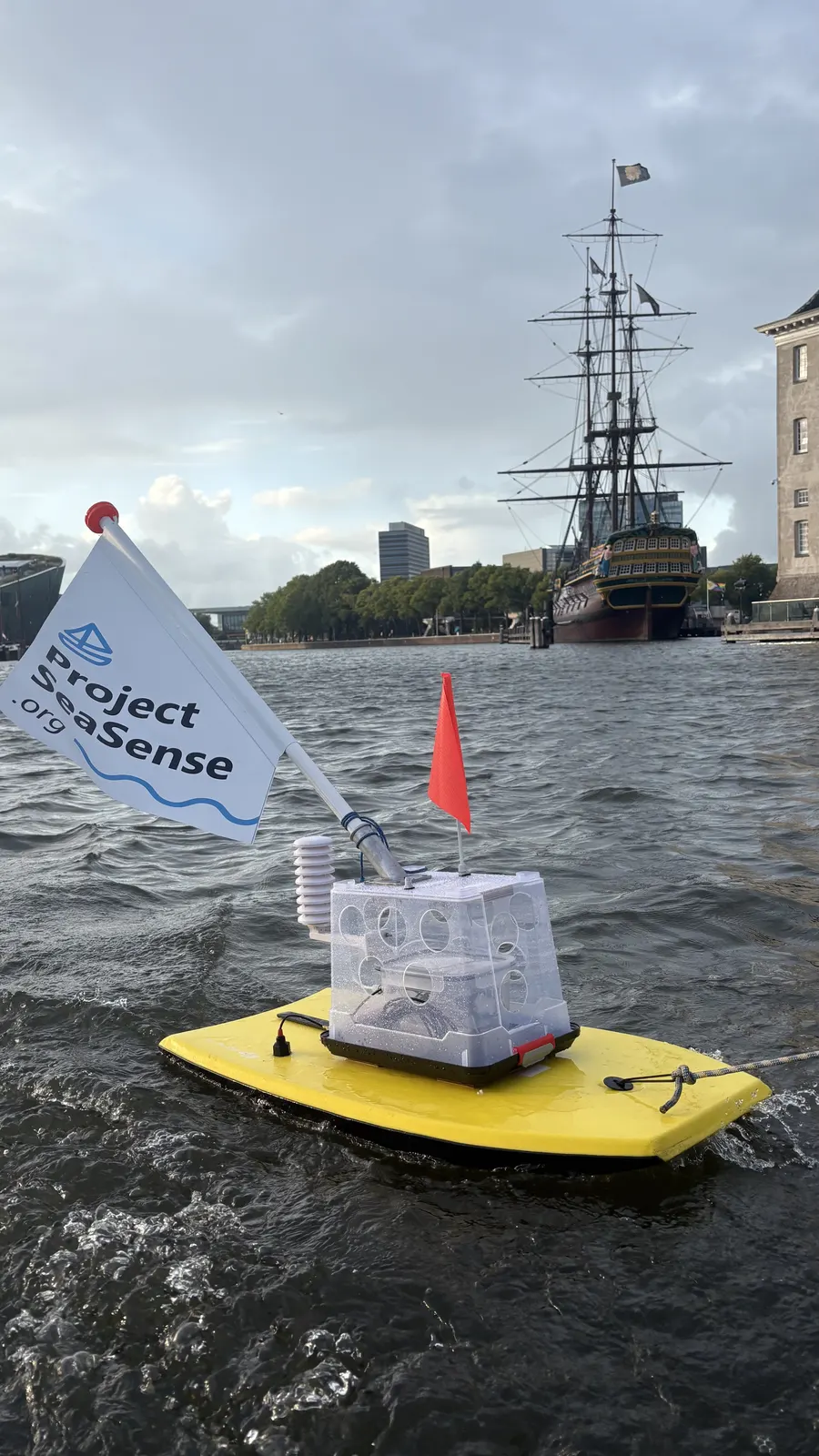
Project SeaSense is an endorsed Decade Project of the UN Decade of Ocean Science for Sustainable Development (2021–2030).
The Ocean Decade brings together the science we need for the ocean we want. Our part: turning the boats already at sea into a coastal observing network, with open data for anyone working on the ocean.
Our Decade Action page (opens in new tab)
Proclaimed in 2017 by the United Nations General Assembly, the UN Decade of Ocean Science for Sustainable Development (2021-2030) ('the Ocean Decade') seeks to stimulate ocean science and knowledge generation to reverse the decline of the state of the ocean system and catalyse new opportunities for sustainable development of this massive marine ecosystem. The vision of the Ocean Decade is 'the science we need for the ocean we want'. The Ocean Decade provides a convening framework for scientists and stakeholders from diverse sectors to develop the scientific knowledge and the partnerships needed to accelerate and harness advances in ocean science to achieve a better understanding of the ocean system, and deliver science-based solutions to achieve the 2030 Agenda. The UN General Assembly mandated the Intergovernmental Oceanographic Commission (IOC) of UNESCO to coordinate the preparations and implementation of the Decade.
Our aim: a coastal observing network made of the boats that are already sailing. Dense enough to calibrate itself, open for science, and funded so it lasts.
2027
About 50 boats of sailors who are out a lot, one full season on the North Sea coast, Wadden Sea, IJsselmeer, Markermeer and Zeeland. The first real fleet. We're looking for funding.
2028
Nodes on charter boats in Croatia, Greece and Turkey, planned with Velamari as part of its fleet service, with the data shared with SeaSense.
2027+
More voyages and hosts beyond the Netherlands, so each new region starts with boats already signed up.
Chair
Ernst Stokvis
Treasurer
Ellen van den Berg
Secretary
Antoinette Hoes
Board member