Host a SeaSense node, wherever you sail
If your boat is out a lot, it can measure the sea for science. We send you a small node; you fit it at your nav station in about 30 minutes, then you just sail.
How it works
Apply
Tell us about your boat and where you sail. Two minutes.
Install
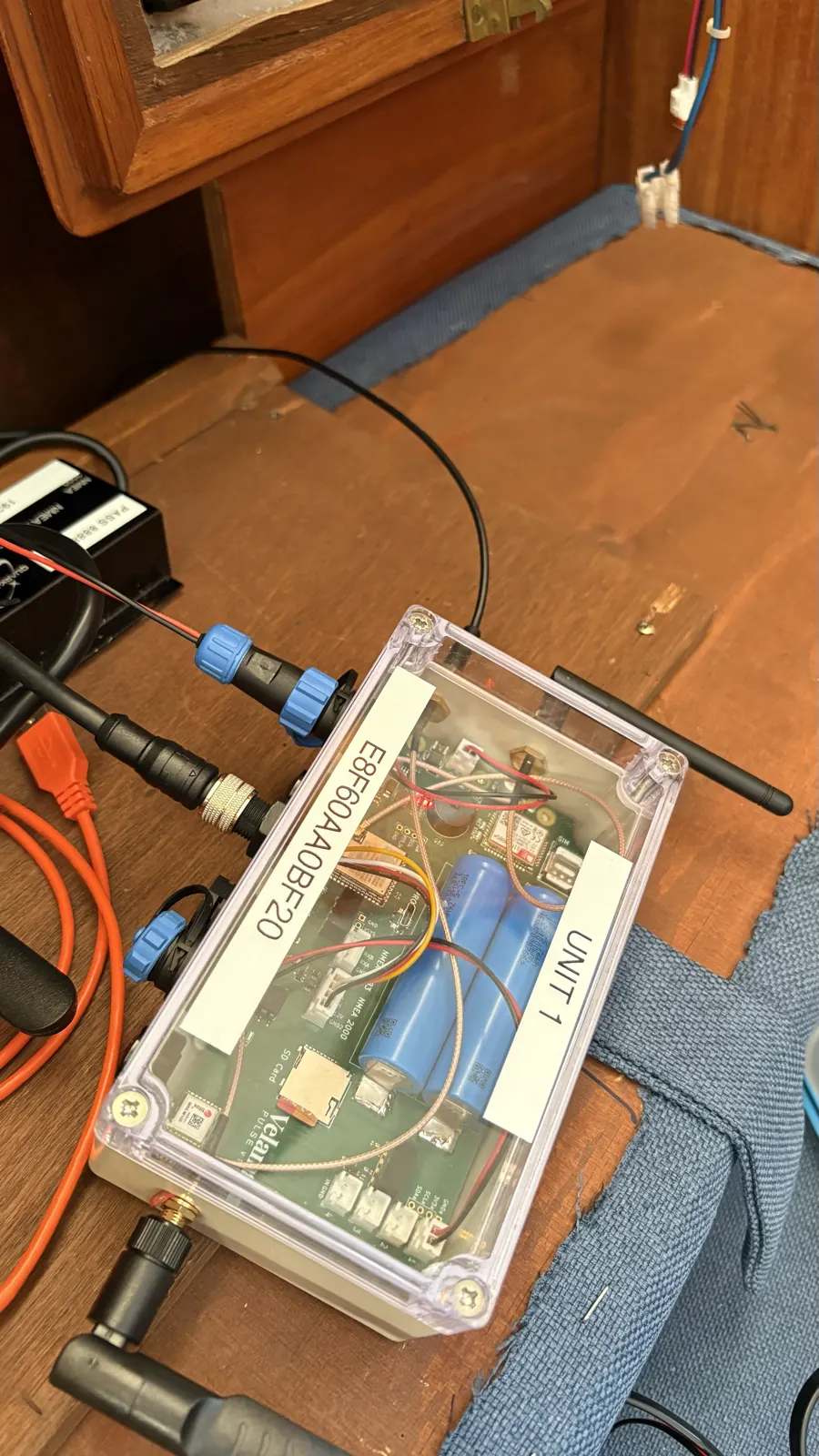
Do it yourself in about 30 minutes: connect it to your NMEA 2000 network or NMEA 0183 output, and to power. It only listens.
Sail
It logs and uploads by itself. Nothing to switch on.
What you need
- You sail often: the more days at sea, the more useful
- Your instruments use NMEA 2000 or NMEA 0183
- Room for a small box and a 12/24 V feed at the nav station
Blauwe Long (Blue Lung) — 2027
Fifty sailors, one season, the Dutch coast and inland seas. Enough boats on shared water to check them against each other. That turns a working prototype into a working network.
Sail a lot on Dutch waters? You're exactly who we're looking for for Blauwe Long 2027.
Apply to host a node
Questions
You join with your own node, which is yours afterwards. It supports the network, and it's useful aboard too. We'll tell you what it costs before you decide.
No. It only listens, through an isolated connection, and can't send anything onto your network.
Science needs positions, so tracks are stored. Researchers get them pseudonymised (a code, never your boat name) and only after signing an agreement not to identify you; only aggregated data is public.
Apply anyway. Blauwe Long is our 2027 Dutch focus, but hosts elsewhere help us plan the next regions.
Very little. While your instruments are on it draws about 75 mA at 12 V, so a 10-hour day of sailing uses roughly 750 mAh. When the boat is idle it switches to a battery-saving mode.
We send nodes out in batches. Dutch waters come first, for the 2027 season. Elsewhere, as we open new regions. Applying now puts you on the list.
No. Installation is self-service and takes about 30 minutes: connect the node to your NMEA 2000 network or NMEA 0183 output, connect power, done. We include simple instructions.
That works too. The node reads one NMEA 0183 output. If several instruments should reach it, connect it to the output of your chartplotter or multiplexer, which combines them.
No. The node has its own cellular connection and uses your Wi-Fi when it's available. When there's no signal it stores data and uploads later.